
This was a year-long project I worked on from start to finish, involving a new content management system, all new content, and shifting from internal categories and mental models to a user-centred information architecture.
I helped select and work with external usability consultants and external specialists in customizing SharePoint. The usability consultants conducted user research and completed a heuristic analysis of our previous site, and created user-tested wireframes with recommendations.
Identifying and meeting user needs
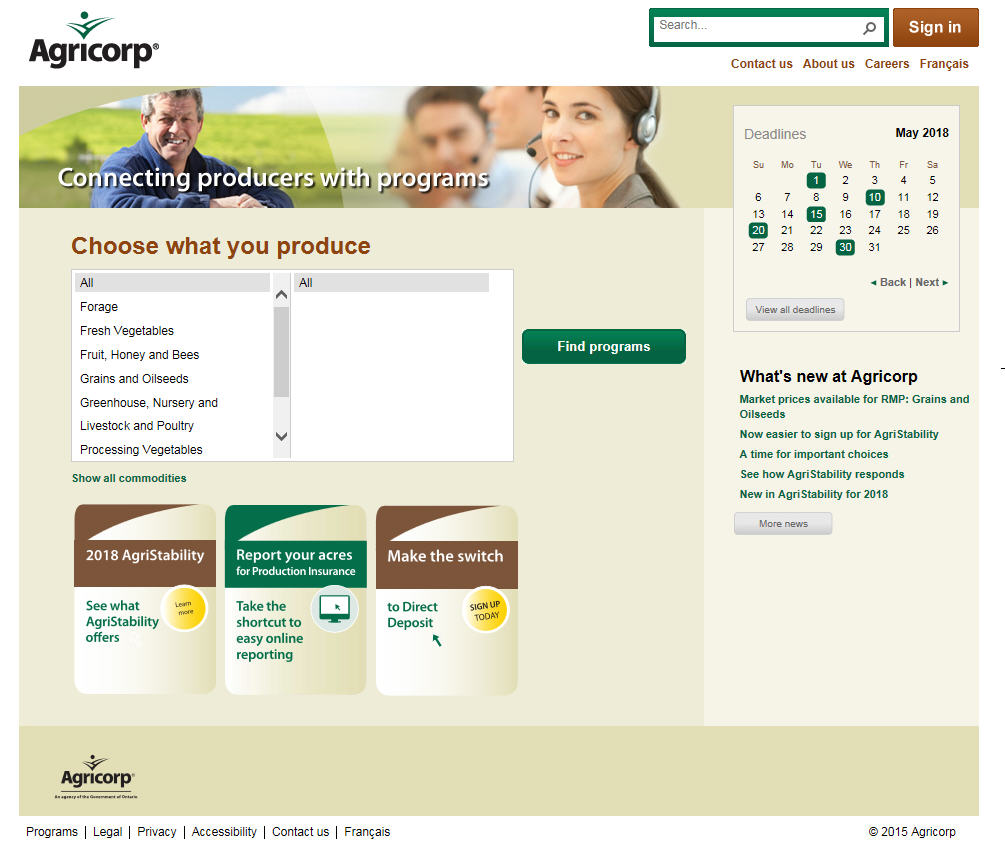
Knowing that our primary user group, Ontario farmers, came to our site to find out what programs they could participate in and program deadlines, we prioritized two parts of the home page:
- a tool for users to choose the commodities they grow that gives them applicable programs instead of forcing them to browse a list of our programs and plans
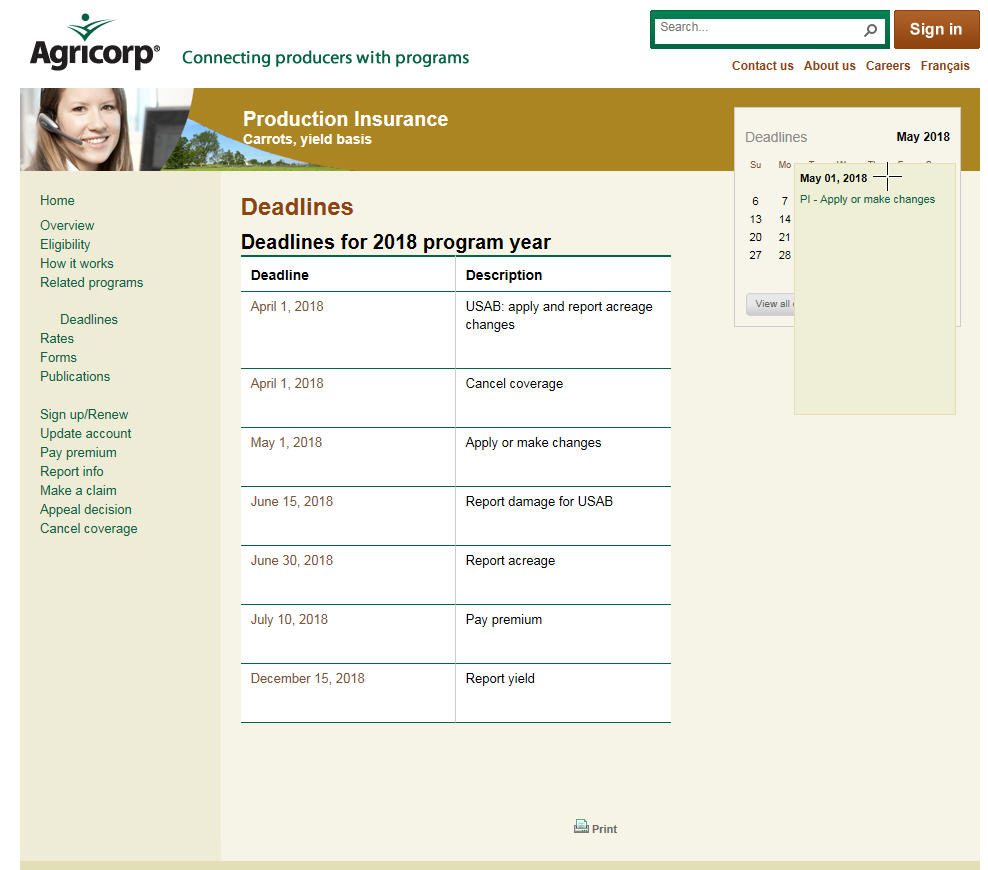
- a deadline calendar that appears on nearly every page of the site, driven by a single source of content but with slightly different content displaying in each different usage scenario.
Complex mapping and modelling of deadline content
In addition to mapping, writing and editing the deadline content for each different context, I worked with developers to define requirements for the calendar functionality.

The content for the deadline calendars was particularly complex to sort out, because one of our key, most complex programs, AgriStability, has an 18-month business cycle, so that two program years are in effect at any point in time. As well, Production Insurance isn’t actually a single program but a group of about 50 insurance plans for different commodities, all with their own terms, coverage details and deadlines, and some commodities can be covered in different ways by multiple plans.

Content strategy for corporate content
We also identified job seekers as a secondary user group, especially since we were growing rapidly at the time, and I created the content strategy for corporate content to meet job seekers’ needs. Because we were so busy figuring out the information architecture, content mapping and sharing, and requirements for customizing the content management system, I selected, guided and edited the work of an external writer to ensure our corporate content was available on time and on brand.
Governance to maintain quality into the future
I also documented our content decisions as we went, which fed into a suite of governance documents (including style guides, editorial policies, roles and responsibilities, and procedures) to ensure the site content remains easy to find and use and relevant well into the future.
 Kate Wilhelm